Diagnoses

Upon hearing the term “diagnoses,’ most students of Christian Science would immediately think of the medical diagnoses of diseases or other physical maladies—and they would generally not want to go in that direction!

Why? Because learning of matter’s view of itself is exactly the opposite of how Christian Science works in healing ourselves and others.  It tends to entrench the problem more deeply in the individual’s thought as the images of the condition and the pronouncements by the medical “authorities” loom in consciousness, thereby generating more fear—the source of the problem to begin with.

Lilacs 05.10.13Instead, we need to be looking to what our omnipresent, omniscient, omnipotent, and omni-active Father-Mother God knows about His/Her perfect creation—you and me.  A creation that always reflects health, harmony, and holiness.  Always!

Yet there are other forms of diagnosis that we might not be so alert to.

Such as?

Well—how about those nightly news reports that talk about the lack of economic growth or job possibilities for the unemployed or those about to enter the work force?

Just last week my wife, Carolyn, and I were watching PBS’s NewsHour which aired a segment about how difficult it was for people in their 50’s and 60’s to find new employment after having been laid off from their previous work.  Individuals told their stories, and psychologists, economists, and other experts chimed in with all the “reasons” for this problem.  The general diagnosis, although all agreed to be unjust, was one deemed pretty bleak.

But is it true?  Is it any different than the medical diagnosis that predicts dire outcomes or increased impediments?

None, whatsoever!

And just like the medical type, this too can be overthrown and seen for what it really is—nothing other than a material belief without power to adversely affect us.

This becomes clear as we rely on our growing understanding of God and recognize that as God’s beloved children—as the reflections and expressions of infinite Mind—we are not subject to any form of limitation.  In any sphere!

Mary Baker Eddy wrote:

God expresses in man the infinite idea forever developing itself, broadening and rising higher and higher from a boundless basis. (Science and Health, p. 258)

There simply are no restrictions in any conceivable direction in that statement—a statement which applies directly to each and every one of us.

And that includes employment.

We are, after all, in the employment of God—as His image and likeness.  And that employment is eternal, unchanging, and ever-fruitful.

It’s an employment that’s always about healing and expressing divine Love—of seeing through the nothingness of error to the reality of Spirit—regardless of what specific field it is manifested in.

As we strive to gain a deeper spiritual understanding of God, of His government, and who we each are as His creation, we’ll be unfailingly led to where He wants to employ—to use—us.

And no barriers of age, gender, human history, etc.—of material diagnoses—can block our way.

Revelation (3:8) in the Bible states it perfectly:

I have set before thee an open door, and no man can shut it:

So, go ahead.  Walk through that open door that God is leading you to.

Be employed as the healer that He has made you to be!

Coasting?

OK—here’s another bicycling metaphor that I think holds an important spiritual lesson.

When cycling up a long climb you have to keep your focus, perhaps struggle, and probably expend a lot of energy.  When you finally get to the summit, you may have a relatively flat area or a sudden descent—both quite wonderful, especially when there’s a beautiful view!

But do you ever really just get to coast?

Appalachian Gap, VT 2012Not from my experience.  Though I may or may not be continuing to physically pedal or strive and struggle in the way that I did when climbing, I still have to be continually alert.  I still have to be very aware of my surroundings—the road surface conditions, corners, traffic, intersections, pedestrians, other cyclists, animals, etc.  I certainly may enjoy the beautiful scenery, or the feeling of freedom that a great descent can provide, but I don’t get to simply relax and “take it easy.”

If I expect to be safe, I must remain vigilant.

And so it is with our spiritual growth.

For instance, we may have worked long and hard to overcome a disease, a relationship problem, or an employment challenge.  And we definitely should rejoice and be grateful for the evidence of God’s goodness and love for us in the defeat of the adversity and our consequent liberation from it.

But do we have the luxury to let our spiritual guard down and feel that we can or even deserve to just “coast” for awhile?  Can we really afford to think that we don’t have to keep pressing on to gain a deeper spiritual understanding—an understanding that allows us to become better healers?

Wouldn’t it be just like the non-intelligent carnal mind–error, evil—to try to “sneak” a suggestion into our thought the moment we stopped watching?  The moment we ceased to be alert?

One might be tempted to think that such a degree of alertness might detract from our joy and rejoicing.  But it can’t for one simple reason.  Spiritual awareness is arrived at by using and exercising our God-given spiritual sense and discernment—an activity that can only enhance our feeling of God’s presence and care for us.

The need to be ever-alert was clearly stated by Mary Baker Eddy:

Be watchful, sober, and vigilant. The way is straight and narrow, which leads to the understanding that God is the only Life. It is a warfare with the flesh, in which we must conquer sin, sickness, and death, either here or hereafter, — certainly before we can reach the goal of Spirit, or life in God.  (Science and Health, p. 324)

There’s nothing there that sounds like coasting to me!

It never happened!

Three simple words—but words that often appear difficult to comprehend.

Whether we’re talking about tragic events, illness and disease, mental health issues, losing a job and financial hardships, or relationship problems, those words can and do have power—if based on the teachings of Christian Science—to wipe the slate clean.  To change our apparent human history and to free us from the lies of the carnal mind that would try to keep us enslaved to its falsities.

You might be wondering how that could possibly be.

To quote a character from the Seinfeld TV show: “Oh it be.  It be!”

Glacial Park, IL 11.24.12You see, error—evil or the carnal mind—is always trying to establish itself in our thought by an association with a supposed beginning of an inharmonious event.  Perhaps the onslaught of an illness, the breakup of a marriage, or perhaps the abuse by another individual, for example.  It whispers to our thought “Don’t you remember when such and such took place?  Don’t you remember what it felt like?  How fearful you were?  How much pain you were in?  How confused you felt or how bitter and angry you were?  Etc., etc., etc.!”  And it does so in a silent, deceptive guise which imputes itself to be our own thinking, thereby attempting to establish a subjective/objective “reality” to itself.

But this does not make it so. That very association, that very event, never really took place in spiritual reality—in the Kingdom of God—the only reality there is and can ever be.  The Bible tells us that God “…is of purer eyes than to behold evil.” (Habakkuk 1)  And in referring to God, Mary Baker Eddy wrote:

There is but one primal cause. Therefore there can be no effect from any other cause, and there can be no reality in aught which does not proceed from this great and only cause. Sin, sickness, disease, and death belong not to the Science of being. They are the errors, which presuppose the absence of Truth, Life, or Love. (Science and Health, p. 207)

This is a radical statement.  A statement that is in total and defiant opposition to all the lies that matter-based thinking asserts and tries to impose on our thinking.  And material thinking can do nothing else other than lie because it is a lie from its supposed start to finish.

Each and every one of us has been nowhere other than in God—in His/Her kingdom.  We have always—without exception—been fully and perfectly sustained by Him as His image and likeness.  Now, it may seem that we’re separated from the Almighty, but that is all such a belief is—an illusion, a fallacy, a fabrication.

As we begin to spiritually understand this fact, and conscientiously apply it to our thought, we will inevitably see the health-giving, life-sustaining, and beneficial results of doing so.

Mrs. Eddy wrote in her book Retrospection and Introspection (p. 22):

The human history needs to be revised, and the material record expunged.

That human history and that material record are revised and expunged by gaining the understanding that only God creates and He/She only causes good.  Any other assertion—no matter how real or dire it may seem to be—is false and has no claim on any of us.

This sacred recognition blesses us and all whom our thoughts rest upon.  It frees us and others from the shackles of mortal mind into the tangible awareness of our existence as the children of God.  Into the freedom that is inherently and always ours.

Into the understanding and experience that indeed it—evil–never happened!

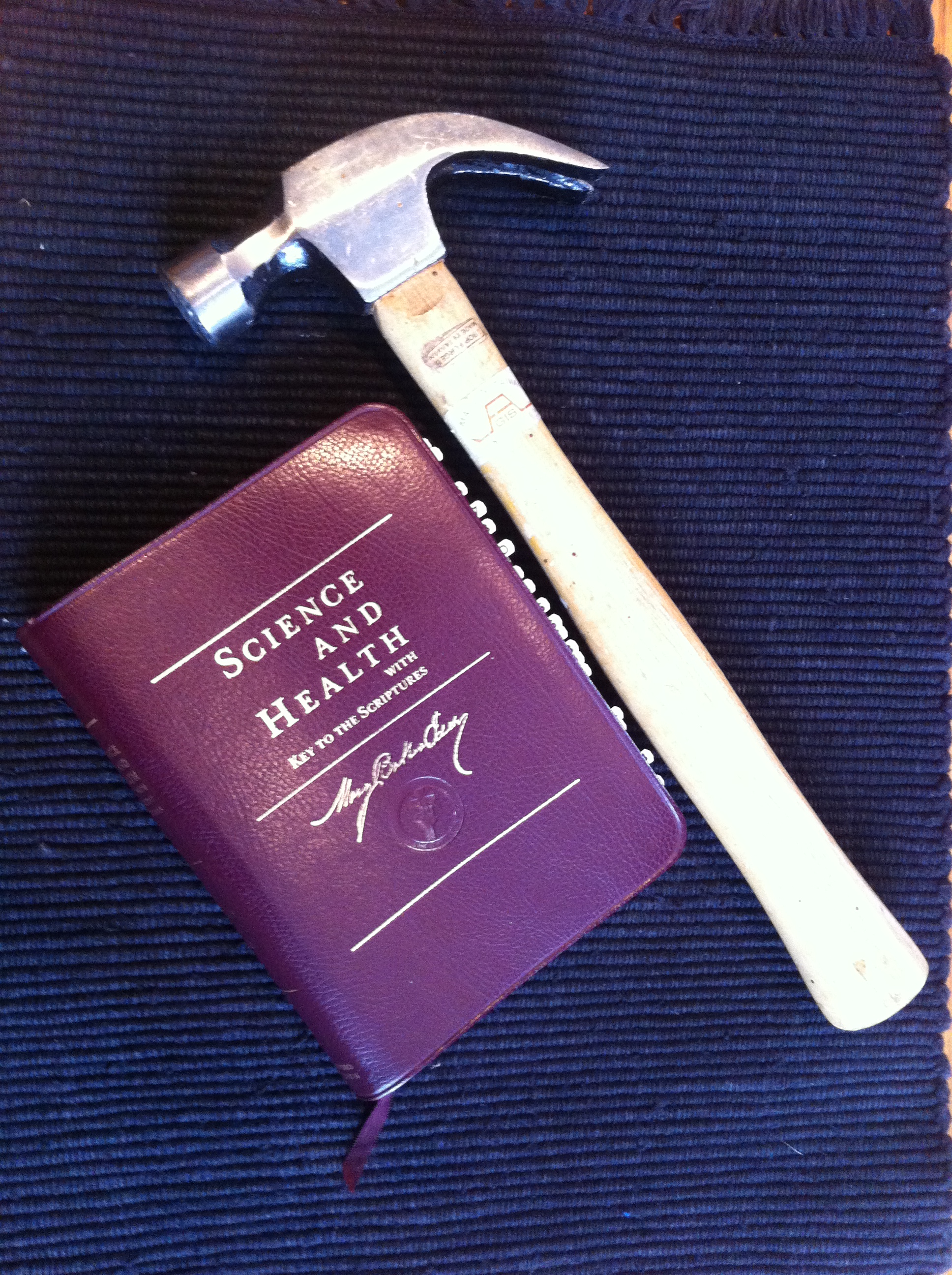
If I had a hammer…

The opening stanza of that famous folk song by Pete Seeger and Lee Hays is familiar to many:

Hammer with Science and Health 04.01.13If I had a hammer

I’d hammer in the morning

I’d hammer in the evening

All over this land

I’d hammer out danger

I’d hammer out a warning

I’d hammer out love between my brothers and my sisters

All over this land

They’re certainly stirring lyrics.  And the writers’ final stanza declaims that they indeed do have a hammer and are using it.

“OK”, you may be saying, “but what has that got to do with Christian Science?”

The answer is very simple.

We do have the hammer—the tool—that brings about freedom from all the ills that the flesh is heir to.  It’s Science and Health with Key to the Scriptures by Mary Baker Eddy.  But to benefit by it, we have to pick it up—not just occasionally or for a sideways glance—and actually study and daily apply the truths contained in this life-changing, radical, and divinely inspired book.  Truths that heal.  Truths that reform.  Truths that regenerate.  Truths that liberate us.

Eddy stated:

Although this volume contains the complete Science of Mind-healing, never believe that you can absorb the whole meaning of the Science by a simple perusal of this book. The book needs to be studied, and the demonstration of the rules of scientific healing will plant you firmly on the spiritual groundwork of Christian Science. This proof lifts you high above the perishing fossils of theories already antiquated, and enables you to grasp the spiritual facts of being hitherto unattained and seemingly dim. (Science and Health, p. 147)

This is a clear, unambiguous statement about our responsibility to study and use those sacred ideas if we expect to bless, be blessed, and heal others.  There’s no wiggle room there.

Yet from time to time, I hear folks wistfully or wishfully claiming that if they only had some spiritual idea or truth that they feel keeps eluding them, everything would be fine—though these same individuals are rarely using the truths that are in the Christian Science textbook.  Often they’ve bought into the suggestion that they just don’t know enough—even though they’re not willing to make the effort to study and bring about the changes they claim they want.

Or they’ve accepted the lie that if they don’t know every detail of how the Science of Christianity actually heals a person of a physical problem, they can’t be healed.

Friends, this is like saying that in order to use a hammer to strike a nail—beyond understanding the basic principles of how to hold, aim, and use it—you first have to know the exact metallurgic composition of the hammer head and the nail, as well as the precise physics involved in accomplishing such a task!

Obviously, that’s absurd!

Likewise, excuses and fear in the guises of inadequacy or ignorance shouldn’t keep us from using the metaphysical truths that we already know or from being willing to dig deeper into the source to attain the desired understanding and healings that we want for ourselves and others.  Let’s just realize that we can’t be made to buy into this ruse of the carnal mind to keep us from using that hammer of healing—the one that puts the nail in the coffin of error.

On page 3 of Science and Health, Mrs. Eddy wrote:

Who would stand before a blackboard, and pray the principle of mathematics to solve the problem? The rule is already established, and it is our task to work out the solution.

Instead of “if I had a hammer”, let’s pick up the one that we already have—and use it!

Validate your parking?

No, I’m not talking about a parking garage!  What I am talking about is where do we park our thought and what concepts are we using to validate it.

This is an extremely important question for each of us to be asking ourselves as Christian Scientists.  In fact, it’s so important that Mary Baker Eddy used the marginal heading “The great question” next to this statement from Science and Health (p. 307):

Above error’s awful din, blackness, and chaos, the voice of Truth still calls: “Adam, where art thou? Consciousness, where art thou? Art thou dwelling in the belief that mind is in matter, and that evil is mind, or art thou in the living faith that there is and can be but one God, and keeping His commandment?” Until the lesson is learned that God is the only Mind governing man, mortal belief will be afraid as it was in the beginning, and will hide from the demand, “Where art thou?” This awful demand, “Adam, where art thou?” is met by the admission from the head, heart, stomach, blood, nerves, etc.: “Lo, here I am, looking for happiness and life in the body, but finding only an illusion, a blending of false claims, false pleasure, pain, sin, sickness, and death.”

Glacial Park, IL Prairie 11.24.12Now, you may be thinking: “Wait—I’m a Christian Scientist and of course my thought isn’t dwelling in matter!”

But are you sure?  What might you be doing to validate where your thought really is lying?

Are you looking to material evidence—medical studies and/or diagnoses—for confirmation of the effectiveness of Christianly-scientific healing?  Have you accepted the false notion that material-based systems of health could in any way possibly validate the power, might, and majesty of Christian Science whose demonstrations of the omnipotence, omnipresence, omniscience, and omni-activity of God alone validate it through the healings that it has and does bring about?

Are you looking to other religious systems to see if they’re similar to Christian Science in a futile attempt to find justifications for the Science of the Christ—the Science which is absolutely unique and which is the only path to the salvation of humanity?  Or might you be investigating elsewhere in a desire to shore up a faltering or flailing sense of devotion and consecration to achieve a healing that’s not coming?

Or perhaps you’re looking to your body for validation of who you think you are—positively or negatively?  Of whether you think you’re attractive or not?  Or healthy or not?  Or successful or not?

Possibly you’ve found yourself seeking answers about Christian Science from other sources than Eddy’s writings—sources that falsely purport to have the “deeper meanings” of Christian Science.  Sources that lure the reader away from the Comforter into a “Twilight Zone-like” state.  To a state away from the healing power of Truth—of God.

And maybe, just maybe, you’ve bought into the concept that you can make a smorgasbord of taking what you feel “comfortable” with from the teachings of Christian Science while mixing it with other religious, philosophical, or psychological systems—not realizing that to do so saps the effectiveness of your turning to Christian Science?

Yet in answer to all of these questions, Mrs. Eddy wrote:

You render the divine law of healing obscure and void, when you weigh the human in the scale with the divine, or limit in any direction of thought the omnipresence and omnipotence of God. (Science and Health, p. 445)

So—the questions for each of us ultimately become:

  • Are we parking our thought, even in part, in matter and looking for validation there?
  • Or are we striving to keep our thinking at one with God—with Spirit—in whom, as the Apostle Paul stated, “… we live, and move, and have our being”? (Acts 17).

The first brings disappointment.

The second fulfillment, healing, freedom—and, yes—validation!

The need to be a sentinel

Edmonton, AB, Canada 2003 1There are so many things that we as Christian disciples need to be alert to—things that would ensnare us and lead us away from the Science of the Christ.  Jesus’ injunction to watch and pray dare not go unheeded.   And the times that we live in give us plenty of opportunity to exercise our divine authority and ability to watch and pray!

One of the phenomena that I’ve noticed over the past several months is an excitement among some Christian Scientists, as well as many adherents of other religious beliefs, about the account of Dr. Eben Alexander’s experience in what he described as the afterlife in his book (A Neurosurgeon’s Journey into the Afterlife), and his subsequent lectures, interviews, and videos about that event.  It apparently has transformed him from a person who was materially-based in his thinking as a physician, to one who now believes that there is indeed life after death.

At this point, you might be asking: “What’s the problem with that?”

Well—his experience, on the surface, certainly sounds quite wonderful.  It’s always good to hear of someone who is beginning to consider and explore spiritual matters.  But there are a few problems with all of this, and ones that I think we need to take into serious consideration.

From what I’ve seen, Dr. Alexander’s relating of his afterlife experience appears to be laced with spiritualism—a mortal-theory/philosophy that is not in accord with the teachings of Christian Science.  And that’s a problem in itself if Christian Scientists are embracing it.  Perhaps, we’re too eager to enthusiastically endorse any sign of what appears to be good, without first asking the question: Is it really good or the imitation of good?

Yet there’s still a greater danger—yes, danger—from all of this: namely the allure of the afterlife.  An allure that presents it as being a desirable place to be.  A place that we might find ourselves wanting to escape to.

I had an intelligent and accomplished professional person—a Christian Scientist—call me for help a couple of weeks ago.  In our conversation, they related to me how they had been reading Dr. Alexander’s book and felt that they would not be in this earthly realm of existence much longer.  They were not experiencing any serious physical problems, but simply felt tired of life and thought that the afterlife, as described in his book, would be a wonderful place to go.  They were quite serious about all of this.  My challenging of this thinking took them by surprise and caused them to begin to rethink their position.

This allure, dear friends, is a subtle siren call of the carnal mind—one that can seem like the antidote to the struggles that we each have to deal with in our lives.  And that desire to find relief from those challenges can be very tempting and impelling.  It’s not that rest and peace aren’t good things—they are—but we first have to overcome the evil that is parading before our thought and seeking  to garner our attention, as well as our identity, rather than look for an escape from handling and defeating it.

Mary Baker Eddy wrote in Science and Health (p. 291):

The suppositions that sin is pardoned while unforsaken, that happiness can be genuine in the midst of sin, that the so-called death of the body frees from sin, and that God’s pardon is aught but the destruction of sin, — these are grave mistakes. We know that all will be changed “in the twinkling of an eye,” when the last trump shall sound; but this last call of wisdom cannot come till mortals have already yielded to each lesser call in the growth of Christian character. Mortals need not fancy that belief in the experience of death will awaken them to glorified being.

And on page 486, she stated:

Death is not the result of Truth but of error, and one error will not correct another.

In short, we cannot afford to see dying in any form as a good or comforting experience.  Death is not some gateway to spirituality that we need to pass through—something that we can look forward to.  It is the last enemy to be destroyed (First Corinthians, 15:26), not sought after!

So—here’s the question: Are we going to resist the beckonings of error—even if they appear to be beautiful—and stand as watchful and prayerful sentinels on the rock of Christ or not?

I know my answer!

Nobility

We’ve been watching Downton Abbey the last few weeks via our cable company’s “on-demand” section and are finally caught up.  It’s been an interesting experience—beautiful scenery, very fine acting, and good writing.

Sky 06.02.11One of the important things that I’ve seen in this series though is an ongoing reform in some of the characters’ sense of their identities as they gradually break away from a false sense of nobility.  A false sense that causes them to hurt others as well as themselves, and misguides and limits them at every turn.  A sense that pervades their thoughts and actions irrespective of whether they are “the nobility” or the servants.

And even though this is just a television series, I find myself asking how many of us are also being motivated by such a mistaken perception?

What do I mean by that?

Well, nobility is a spiritual quality—one of spiritual dignity, a magnanimous and generous character, of spiritual bravery and intrepidness.  It also entails selflessness and self-sacrifice.

Error, however, always presents our thought with an inverted and perverted materially-based view of all that is real and eternal—a view that may seem pleasing or even satisfying, but one that is ultimately self-destructive.

And entwined with this wrongful thought of nobility is another deleterious component—one that would subtly try to tempt those of a spiritual thought into accepting it.

Martyrdom!  Yes, martyrdom—backed by all of the theological misconceptions of the ages–would try to convince us that suffering and/or dying for a cause or principle is a right and noble activity, when it is in fact the exact opposite!

Martyrdom is not God’s intention for us.  Overcoming, not acquiescing to, the beliefs of suffering, disease, sin, or death is what is required of us and is what we are empowered by Almighty God to do through our ever-unfolding understanding of Christian Science.

For example: I’ve had folks call me for help who have been abused by their spouses as well as their adult offspring. These dear ones had been under the delusion that they were being christianly noble by turning “the other cheek”—by allowing the abuse to continue.  Such mesmerism blinded them to not only the truth about their real identities as God’s precious ideas—ideas that are incapable of being abused—but simultaneously prevented the abusers from reforming by allowing it to go on unchecked.   When they became aware of how they had been manipulated by error and how such thinking had nothing to do with Christianity, let alone Christian Science, their lives began to change for the better.

So where does this leave us?

We need to examine our thought carefully and see if we’ve bought into any of these lies about nobility and martyrdom.

Mary Baker Eddy wrote:

We must form perfect models in thought and look at them continually, or we shall never carve them out in grand and noble lives. Let unselfishness, goodness, mercy, justice, health, holiness, love — the kingdom of heaven — reign within us, and sin, disease, and death will diminish until they finally disappear. (Science and Health, p. 248)

Those “grand and noble lives” that Mrs. Eddy spoke of come about through our gaining an understanding of who we each are as God’s creation—of our indestructible relationship to our all-good God.  A relationship that inevitably brings healing to ourselves and others.

In her book The First Church of Christ, Scientist and Miscellany (p. 253), she wrote:

It rejoices me to know that you know that healing the sick, soothing sorrow, brightening this lower sphere with the ways and means of the higher and everlasting harmony, brings to light the perfect original man and universe. What nobler achievement, what greater glory can nerve your endeavor?

Indeed—what nobler achievement can there be?

Words

What’s in a word?  Shakespeare had his character Juliet declaim “What’s in a name? that which we call a rose by any other name would smell as sweet…” indicating that it was not the name that was important, but the identity.

Yet the great bard chose his words carefully.  The words we use convey meaning—convey ideas and concepts—and the usage and awareness of them is of significance.

This is particularly true for Christian Scientists where words and their correct context may indeed have spiritual impacts—impacts that can lead to or away from healing or being healed.

Recently, I’ve become aware of some of my Christian Science friends either using in conversation or posting links on Facebook to a certain word.

What is it?

Soulmate.

Now, this may seem like a fairly innocuous term—even pleasant—so why would I be concerned about it?  It connotes a happy state in a relationship, doesn’t it?

Edmonton, AlbertaOn the surface, perhaps.  But when we actually think about the word and its origins, a different picture emerges.  It traces its roots back to ancient Greek mythology which purports that the gods divided previously androgynous humanity into genders whose souls would long for each other to be complete. In Judaism the beliefs of fate and destiny are added to the longing of separate souls.  While in the late 19th and early 20th centuries, theosophy and Edgar Cayce take up the term in which reincarnation and karma now become intertwined with it.

Therein lies the problem.  Incomplete souls.  Identities that would need another individual—that “perfect soulmate”—to make us complete, to bring us true happiness and fulfillment.  A word that is so imbued with pantheistic beliefs that it really is the antithesis of Christian Science.

Only our immutable relationship with God—a perfect relationship which has always been and will always be—brings happiness and love—love from divine Love, God, Himself.  If our relationships are based on seeking happiness in another human being, then we are in effect forsaking God and worshipping other gods.  And for a Christian Scientist to be thinking and accepting the false concept of individual souls is in itself a problem since only God is Soul and we are each the reflection and expression—the image and likeness—of Almighty, all-good, all-whole God.

Our happiness, whether we’re single or married (and one state is not more holy than the other), can only come from understanding our true relationship—a relationship that is entirely spiritual—to our Father-Mother God.  It’s in that understanding that we find completeness, that we find fulfillment—that we find that Love, God, is the only source of our being.  And it’s spiritually understanding this fact that leads to meaningful relationships with others—relationships that bless and heal.

But if we’re buying into, intentionally or not, a false concept that is loaded with false theology, can we really expect that our healing practices or the healings that we’re seeking won’t be adversely affected?  Can we expect to find happiness and completeness in any of our activities if they’re based on even one false concept?

Mary Baker Eddy’s Miscellaneous Writings (p. 118) states:

To obey the principle of mathematics ninety-nine times in one hundred and then allow one numeral to make incorrect your entire problem, is neither Science nor obedience.

A rose by any other name may smell as sweet, but a name—a word—may not be as sweet as we think.

Wednesdays

Those of a certain generation will recall the 1960’s and ‘70’s TV ad of a little boy named Anthony dashing through Boston’s North End to get home in time for supper because Wednesday was Prince Spaghetti Day!

Assabet River in Concord, MA 1But for Christian Scientists, Wednesdays have a very different significance.  It’s the day that Christian Science churches around the world hold their Testimony Meeting—a service in which attendees testify as to how Christian Science has enabled them to overcome diseases, financial and employment problems, emotional and relationship issues, or any other problem that we all encounter in our experiences.  It’s a time for healing and inspiration.

This meeting, along with the Sunday Service, is required of all Christian Science churches—and by extension their members.

Yet in many branch churches, a fair number of members do not attend those mid-week meetings.

So when did we get to feel that our attendance at this very important meeting was optional—a meeting established by Mary Baker Eddy?

In her Church Manual, Mrs. Eddy stated:

Testimony in regard to the healing of the sick is highly important. More than a mere rehearsal of blessings, it scales the pinnacle of praise and illustrates the demonstration of Christ, “who healeth all thy diseases” (p. 47)

If our testimonies of healing do indeed fit her description—and they certainly should—then how could we at all feel that this is not a demand on us to be present, publicly praising God and proclaiming what the Science of the Christ has done and is doing for us in our lives?

Don’t we all have healings to relate to others?  Haven’t we all been learning things in our study of Christian Science that we can share?

Can we actually be made to believe that it is God who is telling us that our presence and support are not needed?  That we shouldn’t have to testify to the good that He/She has given us?

In other words, what whisperings of the “serpent” are gently blowing on the tympanum of your thought to keep you away?

Perhaps you feel you have so much on your plate with work, family, social obligations, etc., that to attend the Wednesday meeting is just too much—that it’s overload.  I understand busy schedules, but shouldn’t we be making sure that spiritual requirements are the top priority in our lives?  A priority that will bless all of our activities?  A priority that, of even greater import, will help bless and heal someone else?

And think about this:

When all men are bidden to the feast, the excuses come. (Science and Health, p. 130)

So here’s a basic question to ask ourselves—one that cuts right to the heart of the matter: Do we believe that Mrs. Eddy knew what she was doing when she instituted these two weekly services or not?

If we’re Christian Scientists, our answer should only be in the affirmative.  And if so, then we’d better start coming through and living up to what our Leader requires of us.

And remember, unlike Anthony, the feast we’re partaking of on Wednesdays is truly nourishing.

Wednesday is Christian Science Testimony Day!