New JSH-Online Journal Article

My latest JSH-Online The Christian Science Journal Web Original article “Saul or Saul? Choose to be a healer” just went online this morning.  You can read it at: http://journal.christianscience.com/web-originals/2012/saul-or-saul-choose-to-be-a-healer

If you haven’t already done so, you’ll need to subscribe to JSH-Online in order to read this piece as well as the tons of other current articles and articles from the complete archives—worth every penny!

Enjoy!

Squirrels and Spiritual Persistence?

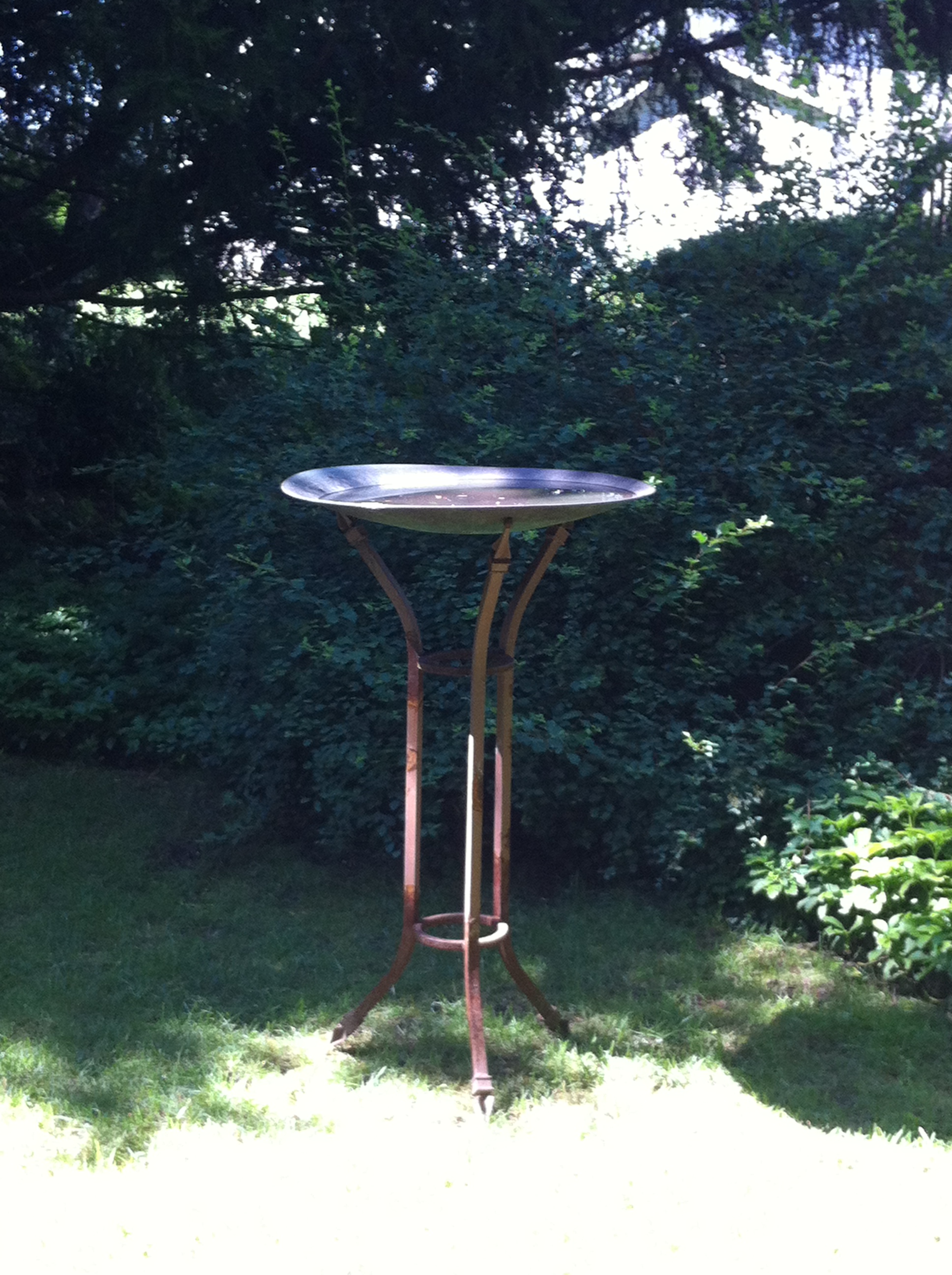
While reading the Christian Science Bible Lesson on my back porch this morning, I saw a squirrel at the base of our rather tall bird bath.  He clearly wanted a drink of water and I wondered how he would get up there.  He first tried climbing directly up, but couldn’t get a claw-hold on the metal supports.  Then he backed up and took a running leap which propelled him directly to the lip of the bath, from which he was able to pull himself up and gain the nourishment he needed.  Pretty neat!

This reminded me of another “squirrel incident” of about 15 years ago. It was one of those heavy and deep New England winters with a lot of snow.  We had put out a bird feeder that claimed to be “squirrel-proof”—a contraption that also had a half-dome shape above it.  The dome’s purpose was to spin and prevent any intruders from gaining access to the bird seed from above.

On one particular day, while practicing the piano, I stopped for a few moments to gaze out the window—a window that had a clear view of the feeder.  On top of a slight snow drift that had built up on the ground beneath the device, sat two squirrels who were eagerly eyeing that food source from below.

What happened next was remarkable.  One of the squirrels climbed the tree and went out onto the limb from which the feeder was suspended perhaps a foot or so below.  He then proceeded to hang upside down, stretching himself to his full extent, and test the dome’s rate of spin with his paw!  He tried several times to leap on the dome but promptly fell onto the drift.  Undaunted, he repeated the process until he correctly ascertained the spin rate and what he needed to do to make the transitional leap to the feeder below— a leap that he succeeded in doing.  But rather than feeding himself first, he knocked food down to his buddy below.

As amazing as all of that was, what followed was even more so.  The two squirrels then changed roles—the 2nd one now heading up the tree and repeating the exact same learning process until success was achieved.  He, too, then knocked the treasure down to the 1st squirrel who was waiting on the drift below to receive his share of the bounty!

A few days later, I told this remarkable story to one of my wife’s work colleagues, who passed it off by saying “What else does a squirrel have to do?  They’re entirely focused on getting food and they have all day to do it!”

I think that individual missed the point.  Here was what to human sense seemed to be an insurmountable problem.  In today’s instance as well as in the one 15 years ago, everything seemed stacked against these furry creatures’ success, yet that focus, that persistence, to receive their nourishment transcended all other considerations.  The degree of “thinking out-of-the-box” and intelligence that was expressed was extraordinary.

And, isn’t that kind of spiritual persistence, focus, and willingness to strive in new directions exactly what we need to be demonstrating in our own spiritual quest—a quest to be truly more Christian by becoming more effective healers as our Master, Jesus, expected of all of his followers?  Shouldn’t that same kind of consecration to the goal of true spiritual nourishment be what our thought is regularly focused on—a consecration whose goal is to feed our neighbor as well as ourselves?

Mary Baker Eddy wrote in Science and Health (p. 518):

The rich in spirit help the poor in one grand brotherhood, all having the same Principle, or Father; and blessed is that man who seeth his brother’s need and supplieth it, seeking his own in another’s good.

Divine Love’s provisions are right there for each of us.  As I’ve seen from my squirrel friends, all we have to do is be willing to really stretch and grasp them!

Are you superstitious?

There’s a line from the sitcom “The Office” in which Steve Carell’s character, Michael Scott (the office manager) says: “I’m not superstitious, but I am a little stitious.”  Hilarious to be sure, but a line that can also have profound implications.

I think most folks conceive of superstitions as being the obvious ones involving black cats, ladders, sidewalk cracks, etc.  And, of course, we’ve all heard of the many athletes and celebrities who indulge in superstitious practices—rigorously and religiously adhering to certain repetitive rituals relative to what they eat, wear, or do prior to performing.  Then there are the superstitions that involve rituals which are endemic to various western and non-western religious practices including occultism, voodooism, tribalism, and so on.  I’m sure you can add more to the list.

But superstition can also involve ideas and actions that are less obvious—less in-your-face, more subtle, and perhaps even more destructive to spiritual growth, health, and well-being.

Any time an action is based on fear, as superstitions inherently are, it necessarily adversely affects our lives by misdirecting our attention away from the omnipotence, omnipresence, omniscience, and omni-activity of our All-good, All-loving, infinite God.  A misdirection—much like a magician’s sleight-of-hand—that would attempt to keep us from feeling and experiencing the palpable presence of divine Love.

So, you might ask, what motivated the topic for this post?  Well, while doing my daily reading of Science and Health by Mary Baker Eddy about a week ago, I came across the following passage (page 149):

We need to understand the affirmations of divine Science, dismiss superstition, and demonstrate truth according to Christ.

I immediately felt impelled to look up the definition of “superstition” in the 1828 edition of Webster’s American Dictionary of the English Language to get a sense of what it would have meant during the author’s lifetime.

Excessive exactness or rigor in religious opinions or practice; extreme and unnecessary scruples in the observance of religious rites not commanded, or of points of minor importance; excess or extravagance in religion; the doing of things not required by God, or abstaining from things not forbidden; or the belief of what is absurd, or belief without evidence.

I’ve got to say that it took me by surprise.  There’s nothing there about black cats or other folklore-ish fables!  No, as you can see, it deals with religious views and practices.

I had to ask myself some questions—questions that we might all want to ponder:

  • Have we unknowingly accepted these more subtle forms of superstition—forms based on repetitive thought, procedures, and actions that are motivated by fear?
  • Have we done so not only in our own lives, but also in our church activities—perhaps in the form of “tradition” or “culture”?
  • And have those traditions and culture—none of which have really anything to do with Christian Science—generated modes of attitude and behavior that are adhered to as if they were Holy Writ?

I think if we’re truly honest with ourselves, we may find that we are obligated to answer “yes” to some, if not all of those, questions.

We might very well ask “How did this happen!?”

In referring to how material thought—and superstition can certainly be classified as that—crept into the spiritual import of the Scriptures and corrupted religious practices, Eddy wrote (Science and Health, p. 141)

This indicates the distance between the theological and ritualistic religion of the ages and the truth preached by Jesus. More than profession is requisite for Christian demonstration. Few understand or adhere to Jesus’ divine precepts for living and healing. Why? Because his precepts require the disciple to cut off the right hand and pluck out the right eye, — that is, to set aside even the most cherished beliefs

Setting aside those cherished beliefs requires not only soul-searching, but the willingness to see through superstition’s fallacies, quickly jettison them, and move forward spiritually.  A forward momentum that makes us more effective in carrying out our individual as well as collective purposes to heal the sick, reform the sinner, and help lift humanity’s thought to holier and brighter views as children of God.

If, as Mrs. Eddy wrote “The time for thinkers has come.” (Science and Health, p. vii)—and it has—then we can’t afford to be even “…a little stitious!”

Pacelines and Healing

OK—so you might be having two questions about the title right off the bat!  What the heck is a “paceline” and what does it have to do with healing?  I’ll be happy to explain!

Have you ever seen a group of bicyclists zipping down the road single file—each cyclist about a foot or so behind the other?  That’s a paceline.  And what it does is conserve energy for the riders—in fact up to 30%.  It works like this: each rider takes a turn at the front of the line literally helping to pull the others down the road.  And the effort for each successive rider in the paceline commensurately decreases till the final rider may actually be expending very little energy.

This concept of “drafting” enables the entire group to go further and faster compared to an individual rider.  But to be really effective, you need to recognize that the closer you get to the rider in front of you, the greater the benefits you and the entire group receive.  To do so confidently, however, involves trust—trusting the skills of those that you’re riding with as well as your own.

Alright, that’s how a paceline works, but before I answer the part about its relation to healing, I’m going to digress a bit.  Trust me, though, it will become clear!

Last Saturday a group of friends and I did a 72-mile roundtrip ride up to Newburyport, Massachusetts.  It was a beautiful day—nice temperature, low humidity, and very little wind.  Idyllic!

At any rate, one of my fellow cyclists was someone that I ride with perhaps 2 or 3 times a year.  She had gained considerable strength on her bike since last year—a good thing to be sure!

But there was a problem.  Whenever the rest of us would get into a paceline, she would inevitably charge ahead, or veer out to the right or left side without warning.  This is not only dangerous but it also effectively defeats the purpose of the paceline.

And it defeated her because she didn’t get the benefits of riding in the line.  The result?  She was exhausted after about 40 miles and finally had to drop off the back for the last 10 miles.

Now back to the second question.  That rider’s actions were very much like any of us who decide we’re going to go it alone rather than rely on God—rather than follow close to Him and receive the blessings that inevitably come from doing so.  And those blessings, of course, include healing of any of the problems that humanity faces—disease, poverty, relationship issues, emotional and mental concerns, lack of achievement, and on and on.

I’ve seen time and again that by aligning my thinking to what I know to be true about the all-goodness of God and His creation—including each of us—and to listen to and obey what He’s telling me, in other words, to get closer to God and trust Him more completely, I’m able to go further and with greater ease in every aspect of my life.  But of greater import, it allows me to be a more effective healer.

The Apostle James summed it up best in his epistle (James 4:8):

Draw nigh to God, and he will draw nigh to you.

Hmm—pacellining with God?  Maybe that’s something worth thinking about!

Is the Repetition of Error Blinding You?

I had an adult piano student back in the 1980’s who had originally come to me for an objective evaluation of his progress.  He had been studying with another teacher for about 3 years, felt that something wasn’t right, and was looking for an outside view.

Well, I agreed to listen to him.  He sat down and “played” a relatively easy piece by J. S. Bach.  You’ll notice that I put the word “play” in quotes.  And I did so intentionally because his performance bore no resemblance to the actual piece.  It was instead a floodwater of wrong notes, musical stuttering, starts and stops, and constant changing of tempi.  Unfortunately, it could only be described as nothing short of horrible!

But the interesting thing here is not about the performance, but about his mental state while playing and his reaction to my critique.  This dear man was completely oblivious to his errors.  He thought that he had done a fine job!

And right now, you might be asking how that could possibly be?

The answer?  He had become so accustomed to and comfortable with these errors that he had been completely mesmerized into thinking that his performance was how the piece should actually sound—a delusion that his teacher had not corrected!

At the end of the evaluation, and after I demonstrated how the piece should be played, he asked if I would accept him as a student—which I did.  It took several months of constant correction by me for him to become alert to his bad habits, hear his mistakes, and begin to understand how to actually make corrections that would last.

In thinking about this experience yesterday, I had to ask myself: How often are we behaving as this student did?  How often are we going through life repeating the same errors, until we not only become oblivious to them, but actually think that this pattern of wrongness is how life should be lived?

If that’s the case, how would we even know that this phenomenon was happening to us?

By praying!  Yes, praying for deliverance from error in all its forms as Jesus taught us in The Lord’s Prayer:

And lead us not into temptation, but deliver us from evil;

In her spiritual sense of this same prayer, Mary Baker Eddy wrote:

And God leadeth us not into temptation, but delivereth us from sin, disease, and death. (Science and Health, p. 17)

This is a clear declaration and affirmation of God’s love and guidance for us.  But what about our responsibility in all of this?  Where do we begin?

There’s a stanza from a poem by Eddy, “The Mother’s Evening Prayer,” that I think is relevant here (Miscellaneous Writings, p. 389):

Love is our refuge; only with mine eye

                Can I behold the snare, the pit, the fall:

His habitation high is here, and nigh,

                His arm encircles me, and mine, and all.

In the past, I had thought that if Love, God, is indeed our refuge—and He is—then it is only the material sense of sight that could cause us to see, believe, and experience the evil—the lie—that is matter-based thinking.

But about 6 months ago, it struck me that this “eye” can also be referring to our spiritual sense of sight—a sense that is entirely sourced in that very refuge of Love, a sense which enables us to see and be alert to the temptations of evil. To the temptations that would snare and trap us into believing that sin and sickness are realities.  To the temptations that would keep us asleep in the dream of matter.

And it’s this spiritual sense—this gift from God which we all possess—that needs to be continually used to avoid those shoals of error.

I’ve often contemplated and found this passage from Isaiah very helpful—for myself and for my patients:

Arise, shine; for thy light is come, and the glory of the Lord is risen upon thee. (Isa 60:1)

Note, that it’s in the present tense.  And also note that it’s a wake-up call to all of us right now!

Are You Tilling the Soil?

Tilling the ground in agriculture is an important and essential activity to bringing up good and bountiful crops—something that we all benefit from.  But what about the kind of tilling that goes on in our thinking—in our consciousness?

What am I talking about?

Well—it’s the type of thinking that involves ruminating, mulling over, and repeatedly digging up the less-than-stellar events of our lives or the ones that we’re afraid might befall us such as illness, disease, heredity, problems associated with aging and decay, failures in relationships, or financial problems—in other words, all that the flesh is heir to.  And these kinds of seeds, sown in the ground of our consciousness, only continue to propagate the same blighted and detrimental harvests—harvests that we surely don’t want to reap.

But is there a way to avoid this?  Mary Baker Eddy wrote “Man is not made to till the soil.” (Science and Health, p. 517)

That’s pretty direct!  Now, the man that she’s speaking of is the real you and me—the man that is our true and only identity as God’s spiritual creation—as the reflection and manifestation of all the qualities of goodness that God, ever-present divine Love, is.

And what of the soil?  It’s the biblical concept of ground or dust as related in Genesis 2:

6  But there went up a mist from the earth, and watered the whole face of the ground.

7  And the Lord God formed man of the dust of the ground,

This dust, this ground, represents matter, error, evil—all that is the antipode of God, good, Spirit, and God’s creation.  It’s the matter-based thinking—the error-filled consciousness—that provides the soil, the seed, and the false crop—the lie that enslaves us and all of humanity in its forbidden fruit.

But we can change all of that by becoming aware of what the soil of our consciousness is—material or spiritual—and likewise, what the seeds are that we’re allowing to be planted—error-induced or God-like.  In each case, it’s the latter that we need to cultivate—to bring to fruition—by fully recognizing, as Paul wrote in his letter to the Philippians (2:13) that “…it is God which worketh in you both to will and to do of his good pleasure.”

Finally, let’s take a look at Eddy’s entire passage about tilling the soil that I cited:

Man is not made to till the soil. His birthright is dominion, not subjection. He is lord of the belief in earth and heaven, — himself subordinate alone to his Maker. This is the Science of being.

It’s a succinct and powerful declaration of the truth—of our real identity and our perfect and indestructible relationship to our Creator.  It’s a statement that underpins and changes the harvest that we reap.  It’s a statement that heals!

Does Meekness equal Weakness?

“Blessed are the meek: for they shall inherit the earth” (Matthew 5:5) is one of Jesus’ most profound statements from his mountainside preachment that became known as “The Sermon on the Mount”.

Yet it can also be one of the most confusing.  Why?  Because “meekness” is frequently equated with “weakness.”

The popular concept of a meek individual too often is of someone who is sheepish, or perhaps devoid of vitality and courage.  I’ve encountered individuals who have thought their reticence was proof of their living a meek life in obedience to Jesus’ sermon.  And I’ve also had others tell me that they thought that meekness was exemplified by being soft-spoken, or retiring.

And then there were those dear folks who thought that they were being meek by allowing others to walk all over them in a misguided concept of being “loving,” and/or that to do so was even some form of spiritual martyrdom to be desired!

So if meekness is not any of the above, what is it?

Mary Baker Eddy wrote in The First Church of Christ, Scientist, and Miscellany (page 228):

Who shall inherit the earth? The meek, who sit at the feet of Truth, bathing the human understanding with tears of repentance and washing it clean from the taints of self-righteousness, hypocrisy, envy, — they shall inherit the earth, for “wisdom is justified of her children.”

For me, there’s nothing in that statement that could be misinterpreted as weakness.  Quite to the contrary!  It’s the willingness to let go of all personal will—to endeavor to be obedient to God’s perfect directions for us and actually do what He is asking us to do and be what He wants us to be—that washes those taints from our human concepts.  Taints that would inhibit spiritual growth—and of greater import—that would lessen our ability to love and heal our fellow man.

Eddy exhorts her readers in Science and Health (page 390) to:

Rise in the conscious strength of the spirit of Truth to overthrow the plea of mortal mind, alias matter, arrayed against the supremacy of Spirit. Blot out the images of mortal thought and its beliefs in sickness and sin.

These active statements clearly indicate there is nothing weak, superficially soft, or indicating a faux-humility about how Christians should respond to any form of error—of evil.  It brims with strength—but a strength that is fully derived from God, not human will power.

One final quote from the same book on page 517 sums up the whole issue for me:

Man is not made to till the soil. His birthright is dominion, not subjection. He is lord of the belief in earth and heaven, — himself subordinate alone to his Maker. This is the Science of being. 

Meekly turning to God—in the strength of Spirit—leads to dominion.  No weakness there!

To Heal or Not to Heal—that is the question!

You may be thinking “What an odd question to ask!  Of course we want to heal!  Who wouldn’t want to heal?”

Well, I think that we have to be honest here and really examine our thinking.  Are we ready and willing to be receptive to the call for help as Jesus was when a woman touched the hem of his garment as he moved through the midst of a huge crowd? (Luke 8:43-48).

Such readiness, willingness, and alertness should be so important to every Christian Scientist—to every Christian.

Mary Baker Eddy wrote in Science and Health (page 450):

The Christian Scientist has enlisted to lessen sin, disease, and death…

I remember when I first read that statement back in 1990 while attending a service at The Mother Church in Boston for the first time.  I had been studying Christian Science off and on for the better portion of a year when I saw those words on a pew card.  As I read them, I thought that this was: a) quite a demand, and b) one that I inherently felt was essential for not only my own salvation, but for that of the world.

Twenty-two years later and I still find that this imperative continues to speak to me.

Eddy wrote (Science and Health, p. 496):

Ask yourself: Am I living the life that approaches the supreme good? Am I demonstrating the healing power of Truth and Love?

I find that I need to ask myself those questions regularly.  Hopefully, you do, too.

Are we really striving to live that life of Love—the life that would be ready to heal anyone in need of healing that comes into our experience?  Are we prepared to offer prayer to our neighbor—to our literal neighbor, or, for instance, those that we meet in a restaurant, at our child’s soccer game, in the grocery store, or those that walk in our church door?

Are we willing to be that light on the hill that Jesus referred to or have we hidden our light under a bushel? (Matthew 5:13, 14)  When the Master commanded his followers to “Let your light so shine before men, that they may see your good works, and glorify your Father which is in heaven” (Matthew 5:16), are we recognizing that this was not an option—that it in fact demands our obedience?

Or have we mistakenly been duped by the carnal mind into thinking that letting our light shine is somehow a passive activity that we just do by our presence without having to engage others? That if we just are nice and think good thoughts, that somehow this will magically transform the world and heal those who are crying for help?

Isn’t that kind of thinking a form of secular humanism or even New Age philosophy?  We can’t afford to buy into those views.  Too much is at stake.

And we certainly can’t be made to fall into the trap of thinking that Christian Science is only about our own salvation and health.  Doing so would be the antithesis of its very purpose.  Why?  Because it would be an act of selfishness—one that would attempt to turn Science and Health into just one among a myriad of self-help books out there instead of what it really is—the cure for all of the ills and sin that plague humanity.

If we truly have “enlisted to lessen sin, disease, and death,” then shouldn’t healing permeate all of our activities—including the reason and purpose for Church?

Lots of questions to be sure, but they ultimately still boil down to this one: To heal or not to heal?  I think the answer should be clear!